Nitrite
The diagnosis of urinary tract infection is based on the identification of a bacteriuria. Most germs causing these infections reduce nitrate to nitrite. The nitrite producing bacteria are Escherichia coli, Enterococcus, Proteus and Staphylococci..
A positive nitrite result is considered evidence of a urinary tract infection. It must be confirmed by bacterial culture and susceptibility testing in order to prescribe appropriate antibiotic treatment.
Even if the urinary tract infection treatment is completed, additional follow-up testing is needed to prevent recurrence. The execution and evaluation of the nitrite test is so simple that the patient may do these prevention tests at home.
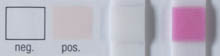
Test strip, from left to right: comparison colored scale, then a negative result, then a positive result. Any kind of reddish coloration is considered positive.
Spezificity
The test strip reactive zone is nitrite specific. The reaction is independent from pH. A reddish coloration in the reactive zone soon after immersion indicates the presence of nitrite.
Potential errors
False negative can be observed in cases of fasting, parenteral alimentation or vegetable deficient diets, because nitrates are not produced endogenously and can only come from food.
False positives are observed with drugs which drugs containing Phenazopyridine.