Erythrocyte casts
Clinical relevance
Erythrocyte casts are cellular casts. The presence of erythrocyte casts is highly pathological and must evoke the diagnosis of acute glomerulonephritis. Erythrocyte casts are also observed in diseases such as systemic lupus erythematosus (nephritis), rheumatoid arthritis, and subacute bacterial endocarditis.
Origin
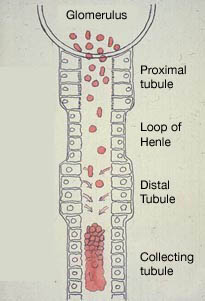
Erythrocytic casts consist of a mucous protein matrix containing incorporated erythrocytes. Erythrocytes are of glomerular origin. Although erythrocytes pass into urine through the damaged tubules, their entrance door is usually an altered basal glomerular membrane (glomerulitis). Thus the presence of red blood cells casts is a marker of glomerular dysfunction.
Identification
Three types of erythrocyte casts can be distinguished:
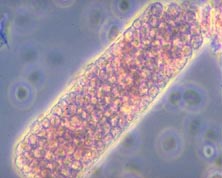
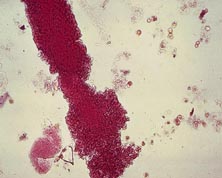
- Casts with incorporated erythrocytes. The rule says that when a third of a cast is composed of a single type of cell, the cast is designated by this cell type.
- Intact erythrocytes along the cast edge, with lysed erythrocytes located at the center.
- Casts in which the erythrocytes are completely degenerated and form a homogeneous brownish-orange mass. These casts are also described as hemoproteic casts.
Erythrocyte casts