Yeast, fungi
Clinical relevance
Yeast most commonly comes from contamination of the urine. They are also observed during metabolic diseases such as diabetes or in case of immunosuppressive treatment such as AIDS.
Origin and identification
Most of the time, it is a contamination and not an endogenous infection.
The fungi or yeast often have filaments (hyphae), organized in a mesh - the mycelium. Budding filaments are frequently observed, especially when the urine was left too long at room temperature.
One can easily confuse yeast with erythrocytes or fat droplets. That is why any round element must be observed carefully in order to identify its origin. Yeast cells are not colored by the Sternheimer-Malbin stain and are rather oval. Candida is the species that is generally found in the urine.
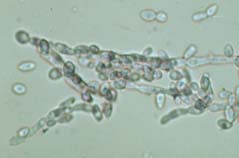
Candida albicans hyphae